
Medical Journal
Published by
Faculty of Medical Sciences,
University of Sri Jayewardenepura,
Nugegoda,
Sri Lanka.
Original Articles
Effects of COVID-19 Pandemic Lockdown on the Physical activity and Mental state of Sri Lankan University Athletes
Mahima S1, Samaranayake M A1, Thalawaththa D B1, Kannangara V N1, Premathilaka T S1, Goonewardene C S E2, Banneheke B M H A3
1Faculty of Medical Sciences, University of Sri Jayewardenepura, Sri Lanka.
2Department of Community Medicine, Faculty of Medical Sciences, University of Sri Jayewardenepura, Sri Lanka.
3Department of Parasitology, Faculty of Medical Sciences, University of Sri Jayewardenepura, Sri Lanka. 3North Wales Medical School, Bangor University, United Kingdom
Corresponding Author: sureshmahima11@gmail.com
Abstract
Introduction: In an effort to mitigate the spread of the COVID-19 pandemic, the government implemented various measures, including home confinement. These measures had unintended consequences on the lifestyle of Sri Lankan university athletes.
Objectives: This study aims to elucidate the effects of the COVID-19 pandemic lockdown on the physical activity and mental well-being of Sri Lankan university athletes.
Methods: An analytical cross-sectional study was conducted among athletes from all government universities in Sri Lanka. Athletes engaged in board games and those studying at private universities were excluded. A stratified sampling method was employed for data collection. A self-administered questionnaire with the International Physical Activity Questionnaire – Short Form and the Short Warwick- Edinburgh Mental Well-Being Scale were utilised in the data collection. Data was analysed using SPSS software version 15.0, with a p-value of less than 0.05 considered significant.
Results: Data was collected from 199 participants representing 13 local universities. The lockdown negatively affected all intensities of physical activity levels (vigorous, moderate activity & walking) with a reduction in the total MET score by 2091.03. The mean total mental score before confinement was 23.08, which decreased to 20.82 during the COVID- 19 lockdown (Δ 2.266), highlighting a decline in the mental state of athletes.
Conclusions: While isolation is a necessary measure to protect public health, the results indicate that it adversely impacts the physical activity and mental well-being of athletes. This may lead to detrimental consequences for the athletes’ long-term careers. The data gathered would be beneficial for future recommendations during similar extended restrictions.
Keywords: COVID-19 lockdown, Sri Lanka, University athletes, Physical activity, mental wellbeing
Introduction
COVID-19, caused by the severe acute respiratory syndrome coronavirus 2 (SARS-CoV-2), is an infectious disease resulting from a newly discovered enveloped RNA virus [1]. Initially, it posed a potentially fatal threat and emerged as a significant global public health concern. The World Health Organisation declared this serious disease a pandemic on 11th March 2020[2]. In response to this global health emergency, numerous countries implemented lockdowns and travel restrictions to mitigate the spread of COVID-19. While these measures effectively reduced the transmission rate of the infection, they also imposed a burden on public health by adversely affecting physical and mental well-being.
Sri Lankan universities offer a range of sports amenities, such as indoor and outdoor fields, swimming pools, sports equipment, and coaching resources to promote the mental and physical wellbeing of student-athletes. Moreover, several interuniversity sporting events, like the Sri Lanka University Games (SLUG), are organised to nurture and support talent across various sports. In 2019, a total of 6,127 athletes from 13 state universities in Sri Lanka participated in the Sri Lankan university games, underscoring the engagement of university students in athletics[3].
Sri Lankan universities and schools were first closed to prevent the spread of the COVID-19 virus on March 12th, 2020.[4] Subsequently, online teaching programs were introduced in educational institutions to bridge the gap in education. However, athletes from these institutions encountered significant challenges in maintaining their training regimens at home.
Research done in these fields has shown that even a four-week cessation of training can lead to numerous physiological changes in athletes’ bodies, resulting in reduced athletic performance and an increased risk of injury upon returning to sport[5]. Sports and exercise play a crucial role in maintaining mental health by reducing anxiety and impact athletes’ psychological well being[6].
Although the effects of COVID-19 on sports have been extensively studied in developed countries, no such inquiry has been conducted in the Sri Lankan university sporting context. Government bodies and university authorities have prioritized educational activities during the lockdown period, but have not given sufficient attention to the field of sports.
Our study mainly aims to assess the changes in physical activity and mental state during the COVID-19 pandemic lockdown among Sri Lankan university athletes. Even though the lockdown phase has concluded, the insights gained will be beneficial for future recommendations during similar extended restrictions.
Methods
This study used an analytical cross sectional design to assess changes in physical activity levels and mental well-being among university athletes during the COVID-19 confinement period. The research was conducted from September and October 2021 and included athletes from 13 Sri Lankan government universities. Participants were selected based on their involvement in university sports, while individuals from private universities and those participating exclusively in board games were excluded from the study.
The sample size was determined using the Lem show formula, with the expected proportion of affected athletes 86.3%[7] and 15% non-response, which yielded a minimum required number of 190 participants. A stratified sampling technique was used to distribute this sample proportionately among the 13 universities, based on athlete participation in the 2019 Sri Lankan University Games. Data collection was facilitated via an online survey using Google Forms, which was distributed across the target universities. Once the required sample size was achieved, further responses were not accepted.
A self-administered, structured questionnaire was used as the primary data collection instrument. The main version of the questionnaire was in English, with translations available in Sinhala and Tamil to accommodate participants’ language preferences. The questionnaire consisted of four sections. Section 1 included an overview of the study’s objectives, inclusion and exclusion criteria, and an informed consent declaration, which participants had to acknowledge before proceeding.
Section 2 gathered socio-demographic information, including gender, ethnicity, and financial status of the participant’s family.
Section 3 assessed physical activity levels using the International Physical Activity Questionnaire – Short Form (IPAQ-SF), a validated tool designed to evaluate the frequency and duration of physical activity in adults aged 15 to 69 years. Participants were asked to report the number of days per week and the amount of time per day they engaged in walking, moderate-intensity, and vigorous-intensity physical activities. Using this data, a weekly total physical activity score (measured in MET-minutes/week) was calculated. This was done by multiplying the minutes they spend by the number of days they put in by a factor specific to each form of physical activity. MET values were assigned as follows: vigorous activity = 8.0 METs, moderate activity = 4.0 METs, and walking = 3.3 METs. The final MET score for each individual was obtained by summing up the MET values for all activity types.
Section 4 evaluated participants’ mental well-being using the Short Warwick-Edinburgh Mental Well-Being Scale (SWEMWBS). This tool comprises seven items assessing aspects of mental health. Participants responded based on their experiences over the preceding two weeks. Responses were rated on a 5-point Likert scale, and total raw scores were converted into metric scores using a standard conversion table. Scores ranged from 7 to 35, with higher scores indicating better mental well-being.
All the questions that were asked in the research tools, used in sections 3 and 4, were presented in a differential format that should be answered directly in sequence regarding “before” and “during” confinement conditions. This differential response format allowed for paired comparisons.
All data were analysed using IBM SPSS Statistics software version 15.0. Changes in physical activity and mental well-being scores before and during the confinement period were assessed using paired sample t-tests. A p-value of less than 0.05 was considered statistically significant. Ethical clearance was obtained from the Ethics Review Committee of the Faculty of Medical Sciences, University of Sri Jayewardenepura.
Results
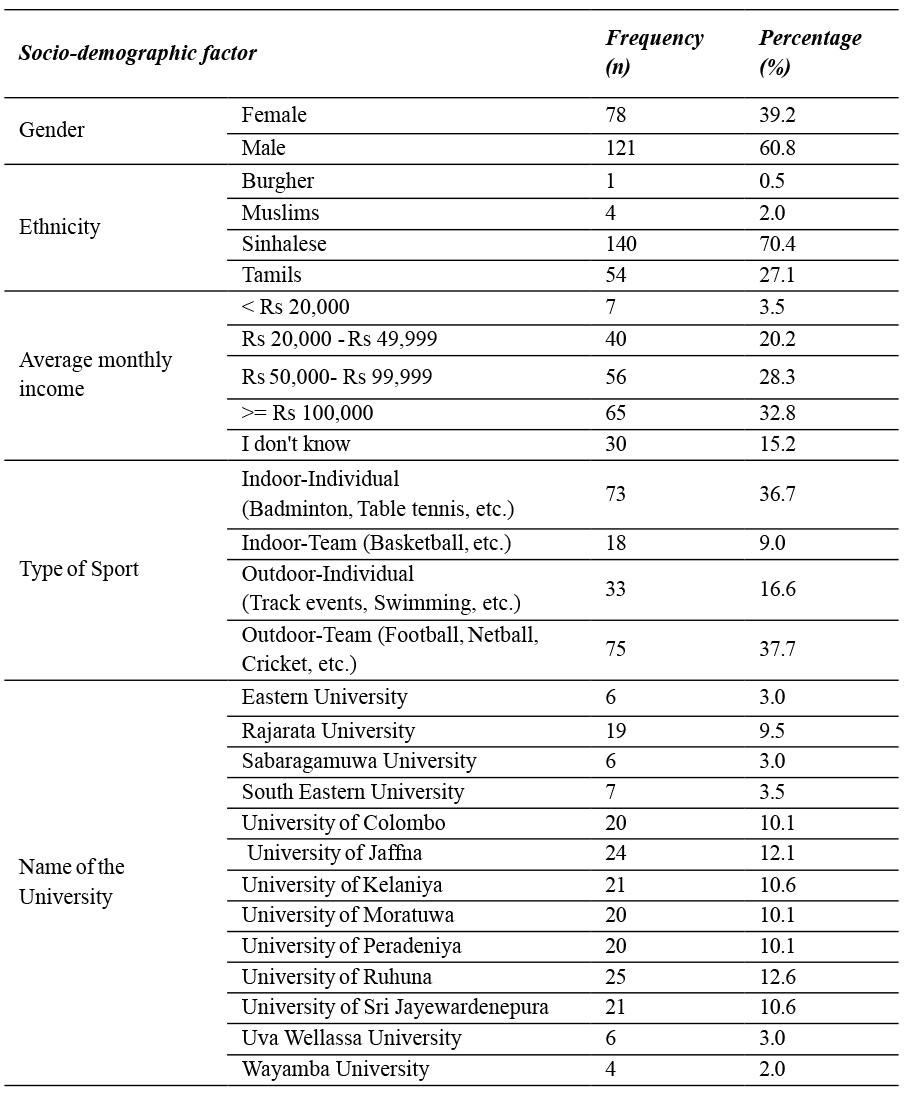
Data were collected from 199 athletes distributed across 13 universities in Sri Lanka. Among the participants, 121 (60.8%) were male, with the majority being Sinhalese (n=140; 70.4%), followed by Tamils (n=54; 27.1%), Muslims (n=4; 2%), and Burghers (n=1; 0.5%). A significant proportion of participants reported an average monthly income exceeding Rs 100,000 (n=65; 32.8%). The University of Ruhuna had the highest representation with 25 participants (12.6%), whereas the University of Wayamba had the least with 4 participants (2%). Of the total participants, 108 (54.3%) were engaged in outdoor sports, while 91 (45.7%) participated in indoor sports. (Table 1)
Table 1: Frequency distribution of the socio-demographic factors of the study sample
Changes in the physical activity of university athletes during the COVID-19 lockdown
Table 2: Changes in vigorous, moderate activities, and walking before and during lockdown
Vigorous activity
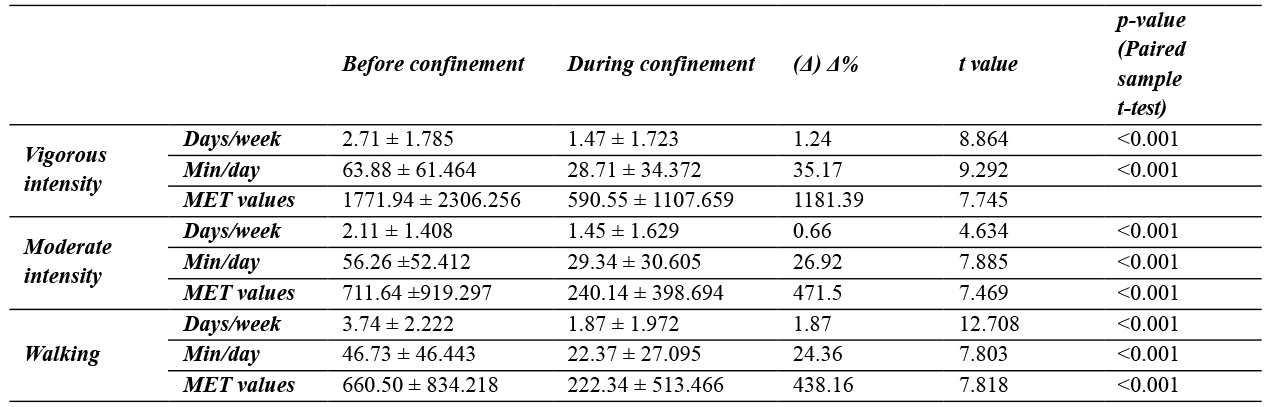
Regarding vigorous activity, the number of days per week of vigorous physical activity during confinement decreased by 1.24 days compared to before the lockdown (t = 8.864, p<0.001). Similarly, the minutes per day of vigorous physical activity decreased by 35.17 minutes (t=9.292, p<0.001). The total MET score for vigorous physical activity during confinement decreased by 1181.39 (t=7.745, p<0.001) compared to the pre-lockdown period. (Table 2)
Moderate activity
The number of days per week and minutes per day of moderate physical activity decreased by 0.66 days (t=4.634, p<0.001) and 26.92 minutes (t=7.885, p<0.001), respectively, during the lockdown compared to before. The total MET score for moderate physical activity decreased by 471.5 (t=7.469, p<0.001). (Table 2)
Walking
In terms of walking, the number of days per week spent walking during confinement decreased by 1.87 days (t=12.708, p<0.001) compared to before. The time spent walking in minutes per day also decreased by 24.36 minutes (t=7.803, p<0.001) during confinement. The MET score for walking decreased by 438.16 (t=7.818, p<0.001) during confinement. (Table 2)
Table 3: Changes in total MET score before and during lockdown

Total MET score
When considering the total MET score, which encompasses all physical activities, including vigorous and moderate physical activities and walking, the mean score before confinement was 3144.07. The mean score during confinement was 1053.04. The difference between these scores is 2091.03, and it is statistically significant (t = 9.49, P<0.001). (Table 3)
Changes in the mental state of university athletes
during the COVID-19 lockdown
Table 4: Frequency distribution of the components of the mental well-being questionnaire, before and during tCOVID-19-19 lockdown
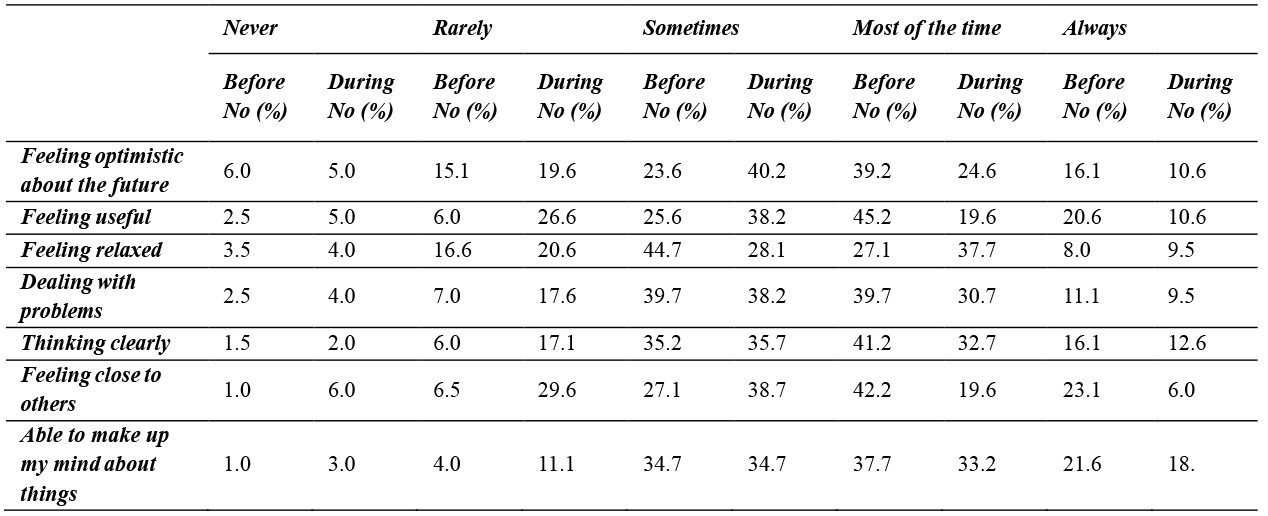
In the study sample, the majority of participants reported feeling optimistic about the future most of the time (39.2%) before the lockdown. However, during the lockdown, most individuals indicated feeling optimistic only sometimes (40.2%). The fewest participants reported never feeling optimistic, both before and during confinement (6%; 5%). Similarly, when asked if they felt useful, the largest proportion of participants responded, “most of the time” (45.2%) before the lockdown and “sometimes” (38.2%) during the lockdown. Regarding feelings of relaxation, most participants reported feeling relaxed “sometimes” both during and before confinement (44.7%; 28.1%), with the fewest responding “never” (3.5%; 4%) during and before confinement. In response to the question about dealing with problems efficiently, the majority indicated “sometimes” and “most of the time” (39.7%) before majority indicated “sometimes” (38.2%). For questions concerning thinking clearly, feeling close to others, and the ability to make decisions, the majority responded “most of the time” before confinement and “sometimes” during confinement. The least number of participants responded “never” to all three questions, both before and during confinement. (Table 4)
Table 5: Changes in total mental score before and during lockdown

The mean total mental score was 23.0816 before confinement and 20.8154 during confinement. The mental score decreased by 2.2662 (t=8.171, p<0.001) during confinement compared to before, which is statistically significant. (Table 5)
Discussion
Our research encompasses data collected from athletes across 13 Sri Lankan universities, with a total of 199 responses. The study underscores the adverse impact of the COVID-19 lockdown on all levels of physical activity, including vigorous, moderate, and walking activities.
The findings of our research are consistent with various research conducted internationally, including studies in Australia[8], Italy[9] and South Africa[10]. The ECLB-COVID19 survey [11], which included 1,047 participants from Asia, Africa, and Europe, demonstrated a reduction in overall physical activity during the lockdown period. The larger sample size, comprising individuals from diverse global regions, yielded results that corroborate our study and strengthen our conclusions; specifically, that lockdowns adversely affect the physical activity of athletes.
Detraining results in numerous anatomical and physiological adaptations across various systems of the human body, including the cardiovascular, respiratory, and musculoskeletal systems. Cardiovascular changes, such as reductions in cardiac diameters, stroke volume, VO2 MAX, and an increase in heart rate, can diminish athletic performance[12]. Additionally, muscle force generating capacity is compromised due to changes in muscle, such as reduced capillary density, enzymatic activity, insulin-dependent glucose uptake, and muscle glycogen stores[13][5]. To address this issue, we propose that universities implement conditioning routines through online platforms to sustain athletes’ fitness levels. These routines should include moderate exercises that accommodate the constraints of physical space and available equipment, such as barbells, weight plates, dumbbells, and resistance bands[14]. For individuals lacking equipment, exercise routines that do not require equipment, such as jogging, squats, burpees, push-ups, sit-ups, and stretching, may serve as viable alternatives[14]. Additionally, it is crucial to minimise prolonged periods of sedentary behaviour, including sitting or lying down, as well as screen time involving televisions, cell phones, computers, and video games during home confinement[14]. Furthermore, it is imperative to implement reconditioning programs for athletes before their return to sports activities to mitigate the risk of injuries[13].
The pandemic period has been associated with an increase in post-traumatic stress symptoms due to changes in athletes’ living conditions, separation from their sports, and concerns about their health. In our study, the mean total mental score before confinement was 23.08, which decreased to 20.82 during the COVID-19 lockdown. Our results support the hypothesis that Sri Lankan university athletes were more adversely affected in terms of mental health during this period.
Similarly, a study conducted among soccer players worldwide revealed that 46% of respondents experienced psychological distress, while 6% suffered from depression and anxiety[15]. A study conducted in Nigeria reported, athletes participating in individual sports experienced more psychological distress when compared to those participating in team sports[6].
Mental well-being is vital for athletes’ health and performance. Therefore, we recommend that university sports clubs conduct workshops via online platforms to enhance athletes’ mental well-being. Additionally, we advise athletes to engage in meditation, deep breathing and new hobbies, such as gardening, to improve their physical and mental health during home confinement[14].
Strengths and limitations
The strengths of this research include the utilisation of validated questionnaires administered in multiple languages, with samples representing all ethnic groups, universities, various types of sports, and all districts of Sri Lanka, except for Mannar. Nonetheless, the study faced limitations, such as recall bias, due to its reliance on questionnaire based data collection, which required participants to recall their physical activity and mental state in their daily lives, as well as before the lockdown.
Conclusions
The findings of this study indicate that home confinement during the COVID-19 pandemic adversely affected the physical and mental wellbeing of Sri Lankan university athletes. Although a lockdown is not currently in place, the information gathered could prove beneficial for policymakers in future lockdown scenarios, as it highlights the importance of considering the physical and mental wellness of athletes in our nation.
Acknowledgement
We would like to express our sincere gratitude to all the participants who gave their kind support for the research by responding to the online questionnaire.
Conflict of Interest
No potential conflicts of interest were reported by the authors
References
- Dousari, M. T. Moghadam, and N. Satarzadeh, “COVID-19 (Coronavirus disease 2019): A new coronavirus disease,” 2020, Dove Medical Press Ltd. doi: 10.2147/IDR.S259279.
- “WHO Director-General’s opening remarks at the media briefing on COVID-19 – 11 March 2020.” Accessed: May 09, 2025. [Online]. Available: https://www.who.int/directorgeneral/ speeches/detail/who-director-general-sopening- remarks-at-the-media-briefing-on covid- 19—11-march-2020
- “Annual Report – 2019 University of Ruhuna,” Matara, 2019. Accessed: May 09, 2025. [Online]. Available: https://www.parliament.lk/uploads/documents/paperspresented/annual-report-university-ofruhuna-2019.pdf
- “OPERATIONAL GUIDELINES ON PREPAREDNESS AND RESPONSE FOR COVID-19 OUTBREAK FOR WORK SETTINGS Interim Guidance Directorate of Environmental Health, Occupational Health and Food Safety MINISTRY OF HEALTH AND INDIGENOUS MEDICAL SERVICES,” Colombo, Apr. 2020. Accessed: May 09, 2025. [Online]. Available: https://www.hpb.health.gov.lk/media/pdf/operational-guidelines.pdf
- Mujika and S. Padilla, “Detraining: Loss of Training-Induced Physiological and Performance Adaptations. Part I,” Sports Medicine, vol. 30, no. 2, pp. 79-87, 2000, doi: 10.2165/00007256-200030020-00002.
- C. Uroh and C. M. Adewunmi, “Psychological Impact of the COVID-19 Pandemic on Athletes,” Front Sports Act Living, vol. 3, Apr. 2021, doi: 10.3389/fsfspor 21.603415.
- Leon, A. Moreno-Tenas, S. Boix, A. García-Naveira, and M. Serrano, “Habits and Psychological Factors Associated with Changes in Physical Activity Due to COVID- 19 Confinement,” Front Psychol, vol. 12, May 2021, doi: 10.3389/fpsyg.2021.620745.
- Elliott, M. J. Drummond, I. Prichard, R. Eime, C. Drummond, and R. Mason, “Understanding the impact of COVID-19 on youth sport in Australia and consequences for future participation and retention,” BMC Public Health, vol. 21, no. 1, Dec. 2021, doi: 10.1186/s12889-021-10505-5.
- Fronso et al., “The effects of COVID-19 pandemic on perceived stress and psychobiosocial states in Italian athletes,” Int J Sport Exerc Psychol, vol. 20, pp. 1-13, May 2020, doi: 10.1080/1612197X.2020.1802612.
- Pillay et al., “Nowhere to hide: The significant impact of coronavirus disease 2019 (COVID-19) measures on elite and semi-elite South African athletes,” J Sci Med Sport, vol. 23, no. 7, pp. 670-679, Jul. 2020, doi: 10.1016/j.jsams.2020.05.016.
- Ammar et al., “Effects of COVID-19 home confinement on eating behaviour and physical activity: Results of the ECLB-COVID19 international online survey,” Nutrients, vol. 12, no. 6, Jun. 2020, doi: 10.3390/nu12061583.
- R. Pedlar et al., “Cardiovascular response to prescribed detraining among recreational athletes,” J Appl Physiol, vol. 124, no. 4, pp. 813-820, Apr. 2018, doi: 10.1152/japplphysiol.00911.2017.
- Sarto et al., “Impact of Potential Physiological Changes due to COVID-19 Home Confinement on Athlete Health Protection in Elite Sports: a Call for Awareness in Sports Programming,” Aug. 01, 2020, Springer. doi: 10.1007/s40279-020-01297-6.
- V Andreato, D. R. Coimbra, and A. Andrade, “Challenges to Athletes During the Home Confinement Caused by the COVID-19 Pandemic,” Apr. 2020, doi: https://doi.org/10.1519/SSC.0000000000000563.
- Håkansson, C. Jönsson, and G. Kenttä, “Psychological distress and problem gambling in elite athletes during covid-19 restrictions-a web survey in top leagues of three sports during the pandemic,” Int J Environ Res Public Health, vol. 17, no. 18, pp. 1-17, Sep. 2020, doi: 10.3390/ijerph17186693